
Full text
Introduction
Cardiovascular disease ranks among the leading causes of discharge of servicemen from active duty for health reasons and accounts for a substantial share of the expert workload of military medical commissions [1–3]. The specific features of military service — the combination of physical, psychoemotional and regimen-related loads with the accumulation of classical risk factors — mean that in personnel with long service CVD is detected earlier and proceeds against a background of already established structural and functional changes [4, 5]. Meanwhile, the expert decision on fitness has traditionally relied on the documented clinical diagnosis and the article of the Schedule of Diseases, whereas measurable functional parameters are used unevenly and depend on the availability of diagnostic methods [1, 3].
To ensure the reproducibility of expert decisions across units, specialists and calendar periods, it is necessary to establish which clinical and functional indices are truly associated with a conclusion of unfitness for further service after adjustment for age, military rank and service profile, and which minimum set of investigations is sufficient for a robust decision. Current approaches to the development and validation of prognostic models [7, 8] make it possible to translate this task into a formalized framework.
The aim of the study was to provide a clinical-epidemiological assessment of the prevalence and structure of CVD-related unfitness for military service according to MMC data for 2014–2024, to identify the independent determinants of an unfavorable expert outcome in a prospective cohort and to develop a prognostic model for its standardized assessment.
Materials and Methods
The study was performed in 2014–2026 at specialized military medical units and expert commissions and was observational and non-interventional. The retrospective part covered 2014–2024: of 1104 identified expert conclusions, 77 (7.0%) were excluded after verification of documentation completeness and compliance with the age criteria; the final cohort comprised 1027 servicemen aged 18–50 years examined by the MMC for cardiovascular pathology. Mean age was 38.9±4.2 years; men, 989 (96.3%); officers, 371 (36.1%); contract service, 976 (95.1%); length of service, 18.8±4.5 years. By service profile, administrative (256; 24.9%), operational (317; 30.9%), guard-duty (352; 34.3%) and combat (102; 9.9%) groups were distinguished. The year of examination, sex, age, rank, service profile, final fitness category, degree of restriction, leading article of the Schedule of Diseases, the fact of repeat examination and documented instrumental investigations were extracted from the records.
The prospective part (2024–2026) was formed by consecutive enrollment of 247 servicemen referred for expert assessment because of CVD; 8 (3.2%) were excluded for non-compliance with the age criteria or concomitant pathology, and 239 subjects entered the analysis (mean age 38.5±4.1 years; men, 96.7%; officers, 38.5%; length of service, 18.6±4.3 years). The cohorts did not differ in age (p=0.177), sex (p=0.793), rank (p=0.493), form of service (p=0.551), length of service (p=0.521) or service profile (p>0.05). All participants gave informed consent; the data were analyzed in de-identified form.
Fitness categories were coded according to the current regulatory definitions: B — fit with certain restrictions, C — fit with limitations, E — unfit in peacetime, fit with limitations in wartime, F — unfit with removal from the military register. The primary endpoint was an unfavorable expert outcome — categories E and F (group 1); categories B and C constituted the reference zone (group 2). Secondary endpoints were the frequency of repeat examinations, the variability of expert decisions and the reproducibility of the formalized model.
In the prospective cohort, all 239 subjects underwent echocardiography with calculation of the left ventricular ejection fraction (LVEF) by the biplane Simpson method and of end-diastolic and end-systolic volumes (EDV, ESV) [9]; Doppler ultrasound of the BCA with assessment of atherosclerotic plaques, degree of stenosis and intima-media thickness (IMT) [10]; ABPM with calculation of 24-h SBP and DBP, the degree of nocturnal SBP dipping and the circadian profile type (dipper, non-dipper, over-dipper, reverse-dipper) [11]; and Holter ECG monitoring with registration of arrhythmias, the number of premature ventricular complexes (PVCs) per day and HRV indices (SDNN, RMSSD) [12]. CAG was performed in the presence of clinical and instrumental indications as a method of morphological verification. Threshold values for standardized interpretation were EF ≤55%, IMT ≥0.9 mm, BCA stenosis ≥50%, 24-h SBP ≥130 mm Hg [6, 14], a non-dipper/reverse-dipper profile, SDNN <90 ms, RMSSD <30 ms, PVCs ≥300 per day, and critical coronary stenosis ≥70% or left main involvement.
Quantitative data are presented as M±SD or Me (Q1; Q3) and categorical data as n (%). Categories were compared by one-way analysis of variance with calculation of η², the Kruskal–Wallis test, the χ² test and Fisher's exact test; associations were expressed as odds ratios (OR) and relative risks with 95% CI. Independent determinants of the E/F outcome were identified by multivariable logistic regression: the basic model included threshold clinical-functional features, and the adjusted model additionally included age, military rank and service profile. Discriminative ability was assessed by the ROC AUC, calibration by the Hosmer–Lemeshow test [13], and the probability threshold by the Youden index [7, 8]; the stability of the effects was verified by stratification according to service profile and rank. Differences were considered significant at p<0.05.
Results
In the retrospective cohort, an average of 93 examinations per year (88–97) were performed. Over 2014–2024, category B was assigned in 225 cases (21.9%), C in 551 (53.7%), E in 167 (16.3%) and F in 84 (8.2%); the unfavorable E+F zone covered 251 conclusions (24.4%). Category C remained central in all years (52.2–55.2%), the share of B declined from 27.8% in 2015 to 19–20% in 2020–2024, whereas the share of E and F decisions gradually expanded (Figure 1).
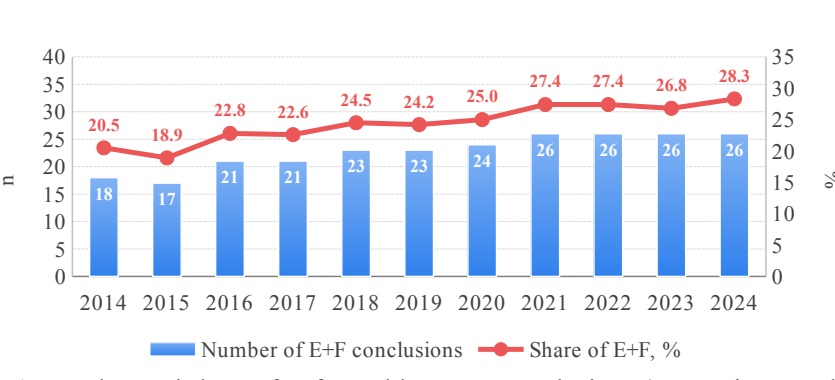
With a stable annual volume, the rise in the E+F share from 20.5% to 28.3% reflected a redistribution within the structure of decisions rather than a change in the number of examinations. The E+F share increased with age — from 23.1% at 18–24 years to 26.6% at 40–50 years, with category F rising from 5.8% to 9.5%. By service profile, the highest E+F share was noted in the administrative group (27.7%) and the lowest in the operational group (21.8%), with intermediate values in the guard-duty (24.4%) and combat (24.5%) groups.
The expert decision was rigidly structured by the leading article of the Schedule of Diseases (Table 1): Articles 45a and 44a belonged entirely to the F zone, Articles 13b and 24 ended in an unfavorable outcome in more than two thirds of cases, whereas the most numerous positions 44c, 45c, 44d, 13c and 13d did not yield a single E/F decision.
| Article | Total, n (%) | E/F, n (%) | OR for E/F (95% CI) | p |
|---|---|---|---|---|
| 45a | 74 (7.2) | 74 (100.0) | — | <0.0001 |
| 45b | 60 (5.8) | 19 (31.7) | 2.00 (1.13–3.53) | 0.019 |
| 45c | 98 (9.5) | 0 (0.0) | — | <0.0001 |
| 44a | 45 (4.4) | 45 (100.0) | — | <0.0001 |
| 44b | 47 (4.6) | 8 (17.0) | 0.84 (0.38–1.82) | 0.851 |
| 44c | 172 (16.7) | 0 (0.0) | — | <0.0001 |
| 44d | 89 (8.7) | 0 (0.0) | — | <0.0001 |
| 13b | 25 (2.4) | 17 (68.0) | 9.45 (4.02–22.22) | <0.0001 |
| 13c | 90 (8.8) | 0 (0.0) | — | <0.0001 |
| 13d | 79 (7.7) | 0 (0.0) | — | <0.0001 |
| 24 | 43 (4.2) | 28 (65.1) | 8.75 (4.58–16.73) | <0.0001 |
Note: article sub-items а, б, в, г of the national Schedule of Diseases are transliterated as a, b, c, d.
Diagnostic practice of the MMC changed substantially over the decade: documented use of echocardiography increased from 43.2% (95% CI 33.3–53.6) in 2014 to 80.4% (70.9–87.4) in 2024, of BCA Doppler ultrasound from 20.5% to 48.9%, and of CAG from 4.5% to 13.0% (Figure 2).
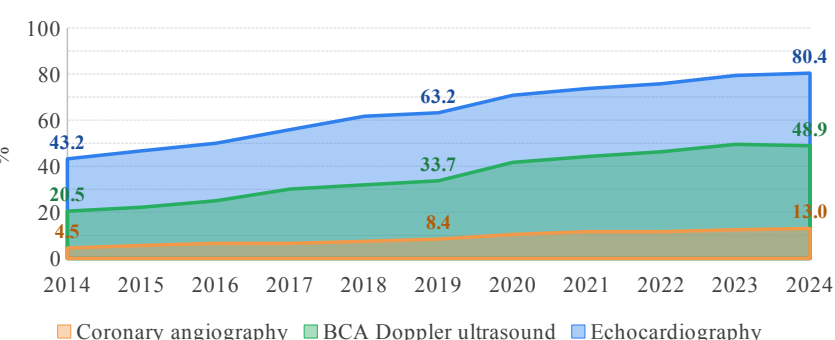
The intensity of examination increased as the decision became more severe: echocardiography was performed in 58.2% of category B cases, 60.7% of C, 73.9% of E and 83.3% of F; CAG was absent in category B and accounted for 5.8% in C, 17.4% in E and 34.8% in F. The maximum diagnostic load fell on Articles 44a (echocardiography 88.9%, CAG 40.0%), 45a (81.1% and 29.7%) and 24 (74.4% and 25.6%), i.e. on the positions forming the core of unfavorable decisions.
Repeat examination was recorded in 148 servicemen (14.4%), and all repeat trajectories originated from an initial category C: of 604 initial C decisions, 456 were final, 133 were reviewed twice and 15 three times. After repeat examination, 95 (64.2%) retained category C, 20 (13.5%) were transferred to E and 33 (22.3%) to F; the share of E/F in the repeat trajectory was 35.8% versus 22.5% after a single decision (OR 1.92; 95% CI 1.33–2.77; p=0.0009), and after a third examination it reached 60.0% versus 33.1% after a second (OR 3.03; 95% CI 1.02–9.06; p=0.049). Repeat examinations were more frequent in the administrative (18.0%) and operational (16.4%) groups than in the guard-duty (12.2%) and combat (6.9%) groups (χ²=9.73; p=0.021), at 35–50 years of age (16.3% vs 10.1%; OR 1.74; 95% CI 1.14–2.64) and under Articles 45c (32.7%; OR 3.40; 95% CI 2.13–5.41), 13c (25.6%), 44d (23.6%) and 44c (23.3%), whereas no repeat decisions occurred under Articles 45a, 45b and 44a.
In the prospective cohort, category B was assigned to 48 subjects (20.1%), C to 130 (54.4%), E to 39 (16.3%) and F to 22 (9.2%); 61 subjects (25.5%) had the unfavorable E/F outcome. The distribution of categories did not depend on service profile (χ²=14.02; p=0.300), although the share of C was highest in the combat group (59.1%), and differences by rank were at the margin of significance (χ²=7.82; p=0.050) with a higher share of E/F among enlisted personnel (27.9% vs 21.7% among officers). As in the retrospective cohort, E/F outcomes were concentrated in Articles 44a, 45a, 13b and 24 (χ²=58.41; p<0.0001). Clinical and functional indices formed a consistent gradient across the category scale (Table 2).
| Parameter | B (n=48) | C (n=130) | E (n=39) | F (n=22) | p |
|---|---|---|---|---|---|
| LVEF, % | 61.7±4.7 | 57.9±5.8 | 51.6±6.4 | 44.8±7.1 | <0.0001 |
| LV ESV, mL | 47±12 | 55±15 | 69±18 | 87±22 | <0.0001 |
| LV EDV, mL | 121±20 | 130±23 | 143±25 | 158±27 | <0.0001 |
| IMT, mm | 0.80±0.11 | 0.87±0.13 | 0.96±0.14 | 1.05±0.15 | <0.0001 |
| 24-h SBP, mm Hg | 127±10 | 133±11 | 142±12 | 148±13 | <0.0001 |
| Nocturnal SBP dipping, % | 11.6±4.5 | 9.4±5.0 | 6.8±5.2 | 3.2±6.1 | <0.0001 |
| PVCs per day, Me (Q1; Q3) | 45 (0; 120) | 120 (40; 260) | 310 (160; 650) | 780 (400; 1200) | <0.0001 |
| SDNN, ms | 116±26 | 103±28 | 88±25 | 74±22 | <0.0001 |
| RMSSD, ms | 34±12 | 30±11 | 24±10 | 20±8 | <0.0001 |
LVEF showed the strongest association with fitness category (η²=0.289), and ESV (η²=0.228) outperformed EDV (η²=0.110) as a marker of contractile failure. Already in category C, 30.0% of the subjects had EF ≤55%, 41.5% had IMT ≥0.9 mm, 69.2% had 24-h SBP ≥130 mm Hg, 55.4% had a non-dipper/reverse-dipper profile, 30.0% had arrhythmias and 31.5% had SDNN <90 ms. The frequency of threshold deviations along the principal functional axes increased from category B to F (Figure 3).
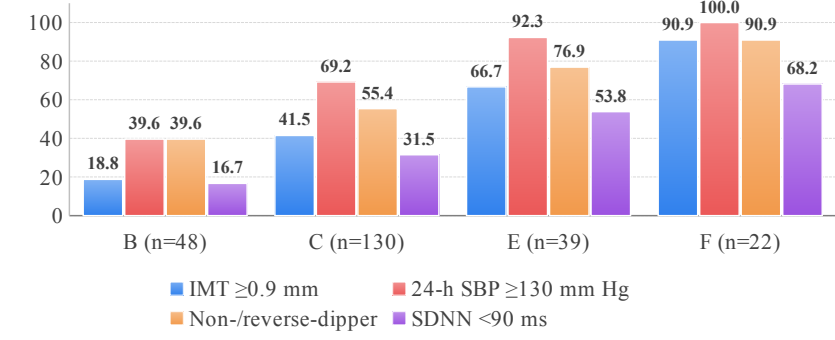
Atherosclerotic plaques in the BCA and stenosis ≥50% were significantly more frequent in E/F than in B–C (OR 4.92; 95% CI 2.55–9.50 and OR 7.05; 95% CI 3.36–14.80, respectively): stenosis ≥50% was found in 39.3% of E/F versus 8.4% of B–C, i.e. it was a specific but insensitive marker. Among the 55 servicemen who underwent CAG, critical stenosis was detected in 13.3% of category C, 76.5% of E and 87.5% of F (χ²=15.84; p=0.0032; OR for E/F vs B–C 6.18; 95% CI 2.04–18.74). Arrhythmias on Holter monitoring were recorded in 16.7% of B, 30.0% of C, 51.3% of E and 68.2% of F (p<0.001), and PVCs ≥300 per day in 10.4%, 21.5%, 38.5% and 59.1%, respectively.
In univariate analysis, the strongest associations with E/F were shown by EF ≤55% (78.7% vs 24.7%; OR 11.24; 95% CI 5.44–23.22) and 24-h SBP ≥130 mm Hg (95.1% vs 61.2%; OR 12.24; 95% CI 3.58–41.84); vascular markers (IMT ≥0.9 mm — OR 5.60; stenosis ≥50% — OR 7.05) and electrical/autonomic features (PVCs ≥300 — OR 3.73; SDNN <90 ms — OR 3.79; RMSSD <30 ms — OR 4.57; non-/reverse-dipper — OR 4.35) were also significant (all p<0.001). In the basic multivariable model, four features retained independence (EF ≤55% — OR 6.43; 24-h SBP ≥130 — OR 5.17; BCA stenosis ≥50% — OR 3.39; SDNN <90 ms — OR 2.51), whereas IMT ≥0.9 mm, circadian profile type, PVCs ≥300 and RMSSD <30 ms lost significance after adjustment for the correlated indices. The results of the adjusted model are given in Table 3.
| Predictor | OR | 95% CI | p |
|---|---|---|---|
| LVEF ≤55% | 6.08 | 2.42–15.29 | <0.0001 |
| 24-h SBP ≥130 mm Hg | 4.78 | 1.37–16.66 | 0.014 |
| BCA stenosis ≥50% | 3.21 | 1.33–7.73 | 0.009 |
| SDNN <90 ms | 2.37 | 1.06–5.31 | 0.036 |
| Age (per 1 year) | 1.03 | 0.96–1.10 | 0.396 |
| Enlisted personnel | 1.49 | 0.62–3.57 | 0.370 |
| Service profile (factor as a whole) | — | — | 0.284 |
The adjusted model showed high discriminative ability (AUC 0.891; 95% CI 0.838–0.944 vs 0.884 for the basic model) with satisfactory calibration (Hosmer–Lemeshow test p=0.58). At a probability threshold of 0.20, sensitivity was 82.4%, specificity 81.0%, accuracy 81.2%, positive predictive value 42.4% and negative predictive value 96.2%. On stratification by service profile, the OR ranged from 5.4 to 6.8 for EF ≤55%, from 4.2 to 5.1 for 24-h SBP ≥130, from 3.0 to 3.6 for BCA stenosis ≥50% and from 2.2 to 2.6 for SDNN <90 ms; by rank, the corresponding ORs were 5.7 and 6.3, 4.4 and 4.9, 3.1 and 3.3, and 2.1 and 2.5 for officers and enlisted personnel, confirming the transferability of the model across organizational segments.
Discussion
The retrospective analysis revealed a gradual but steady expansion of the zone of unfavorable expert decisions in CVD: whereas at the beginning of the decade unfitness for further service was established in every fifth examinee, by 2024 it was established in more than every fourth. This shift developed in parallel with the growth in documented use of echocardiography, BCA Doppler ultrasound and CAG, which allows it to be interpreted as the result of better diagnostic support of decisions rather than merely of a heavier contingent; similar trends — the concentration of CVD-related discharge in older age groups and the dependence of decisions on the completeness of examination — have been described in other military populations [1–3, 5].
Importantly, the core of unfavorable decisions was formed by articles with a rigid clinical-expert profile (45a, 44a, 13b, 24), whereas expert variability was localized within category C: all repeat examinations originated from it, and one third of them ended in transfer to E/F. In the prospective cohort, category C proved to be not a zone of "mild" restrictions but a set of borderline functional profiles: in 30% of such servicemen EF did not exceed 55%, in two thirds 24-h SBP was ≥130 mm Hg, and in one third SDNN was reduced. This explains why the difference between C and E/F is determined not by a single diagnosis but by a measurable configuration of the functional profile.
Multivariable analysis showed that the unfavorable outcome is formed by the combination of four independent axes — LV pump function, 24-h hemodynamic load, organic vascular damage and autonomic dysregulation. The loss of significance of IMT once stenosis ≥50% was included, and of RMSSD once SDNN was included, reflects the membership of these pairs in single vascular and autonomic domains, in which the "harder" feature absorbs the information of the more sensitive one [10, 12]. Neither age within 18–50 years, nor rank, nor service profile retained an independent contribution, and the OR values remained stable across strata, which meets the requirements for transferability of prognostic models [7, 8]. The high negative predictive value (96.2%) has direct organizational significance: at a low predicted probability of E/F, in-depth examination can be deferred and resources redirected toward borderline profiles.
The limitations of the study relate to the dependence of the retrospective data on the quality of archival documentation, the selective performance of CAG, the small number of observations in the combat group and in category F, and the lack of external validation of the model, which determines the need for its verification in independent cohorts.
Conclusion
- In 2014–2024, unfavorable expert decisions (categories E and F) on CVD accounted for 24.4% of MMC conclusions, with their share rising from 20.5% to 28.3% at a stable annual volume of examinations; they are concentrated in Articles 45a, 44a, 13b and 24, in the 40–50-year age group and in the administrative service profile.
- Documented use of echocardiography, BCA Doppler ultrasound and CAG increased 1.9-, 2.4- and 2.9-fold; the diagnostic load is greatest in categories E and F. Repeat examinations (14.4%) originate exclusively from category C and increase the probability of E/F (OR 1.92), which identifies category C as the principal zone of expert variability.
- In the prospective cohort, as the fitness category worsens, a gradient of declining LVEF and HRV and of increasing IMT, 24-h SBP, ventricular ectopy and the frequency of a non-dipper/reverse-dipper profile is formed; critical coronary stenosis in E/F is detected in 76.5–87.5% of CAG cases.
- The independent determinants of an unfavorable expert outcome are EF ≤55% (OR 6.08), 24-h SBP ≥130 mm Hg (OR 4.78), BCA stenosis ≥50% (OR 3.21) and SDNN <90 ms (OR 2.37); the model with an AUC of 0.891, sensitivity of 82.4%, specificity of 81.0% and a negative predictive value of 96.2% is reproducible across service-profile and rank strata and defines a minimally sufficient diagnostic package for standardizing the expert decision.