
Full text
Source and licence. Originally published by Scientific & Academic Publishing in American Journal of Medicine and Medical Sciences, Vol. 15 No. 1 (2025), pp. 135-139, DOI 10.5923/j.ajmms.20251501.25. Republished under the Creative Commons Attribution 4.0 International licence (CC BY 4.0). View the original article.
1. Relevance
Rheumatoid arthritis continues to be one of the most relevant pathologies in modern medical practice: on the one hand, this contributes to the prevalence of the disease – up to 2% in the general population; on the other handhigh social and economic importance process, based on high rates of permanent disability in patients and the significant cost of treatment and the necessary laboratory monitoring [12].
According to the World Health Organization, 60% of the world’s population has gastritis (2023). The frequency of morphological changes in the gastric mucosa is 80% among the adult population. About 40% of the adult population suffers (with more or less pronounced symptoms), but only 5% go to doctors with complaints. More than 30 million people in the world take NSAIDs daily, and in 2/3 of cases – without prescription or medical supervision [1].
An annual increase in the number of hospitalizations and deaths associated with complications of NSAID therapy is reported, and the economic costs of their treatment are increasing. Thus, up to 60% of hospitalized patients with gastric bleeding indicate previous use of NSAIDs. The medical and social significance of the problem is such that rheumatologists often call NSAID gastropathy the “second rheumatic disease [13].”
Rheumatoid arthritis (RA) is a chronic disease that requires long-term therapy and causes drug-induced pathology of the gastrointestinal tract (GIT). NSAIDs are an important component of complex therapy for rheumatic diseases (RD). At least 68.5% of patients with rheumatoid arthritis regularly take NSAIDs [12]. In the absence of effective therapy, life expectancy in patients with RA is 3 years lower in women and 7 years lower in men, primarily due to the high risk of developing comorbid diseases – cardiovascular pathology, osteoporosis, severe infections, interstitial lung disease, cancer [15].
In many patients with RA, life prognosis is as poor as in lymphogranulomatosis, type 2 diabetes mellitus, three-vessel coronary artery involvement, and stroke. RA causes permanent disability in half of patients within the first 3-5 years from the onset of the disease, and after 20 years a third of patients become completely disabled [15].
Rheumatoid arthritis (RA) is a chronic disease requiring long-term therapy and causing drug pathology of the gastrointestinal tract (GIT). In the mid-90s. XX century impressive statistics dictated the need to talk about the “epidemic” of this pathology. The use of non-selective NSAIDs has been shown to increase the risk of gastrointestinal bleeding by more than 4 times. The incidence of NSAID gastropathy reached 4% in regular NSAIDs, and the total number of deaths due to this pathology reached 5-15 per 100 thousand people per year [2].
In recent years, significant advances have been made in the treatment of RA, which is associated with the expansion of the possibilities of early diagnosis of the disease and timely therapy with non-steroidal anti-inflammatory drugs (NSAIDs). However, their use is associated with the development of a number of side effects, the most common of which is NSAID gastropathy. This complication is characterized by the occurrence of erosive and ulcerative defects on the mucous membrane of the stomach and duodenum [2].
Despite a large number of works devoted to the problem of diagnosis and prevention of NSAID gastropathy, the incidence of erosive-ulcerative lesions of the mucous membrane of the gastroduodenal zone and life-threatening complications remains high [2].
The widespread introduction into clinical practice of safer selective cyclooxygenase-2 inhibitors (SOG-2) and effective “gastroprotective” drugs is of great preventive importance. Existing international consensus documents recommend stratifying patients taking NSAIDs into risk groups according to their risk factors, which makes it possible to determine the treatment and prevention of NSAID gastropathy [2].
The aim of the study was to assess the risk of gastroduodenal SD erosive ulcers induced by NSAIDs based on clinical characteristics and morphological parameters of gastric SD in experimental animals with simulated rheumatoid arthritis with RA.
2. Materials and Methods
The study was carried out in 3 stages: Retrospective, prospective and morphological experiment, we mainly focus on verified information using the prospective method. In the rheumatology department of the Bukhara Regional Multidisciplinary Medical Center, 138 patients treated with rheumatoid arthritis in 2022 were analyzed.
3. Results
During a study in the rheumatology department of the Bukhara Regional Multidisciplinary Medical Center, 138 patients aged 19-76 years who received inpatient treatment for rheumatoid arthritis were selected for 6 months (January-June) 2022. The diagnosis of Pevmatoid aptitis was made based on the ACR (1987) and ACR/EULAR (2010) tests. When identifying the disease, the following data were analyzed in detail: the age of the patient, the nature of the disease, its duration, the presence of asopate in the disease, the results and effectiveness of previous treatment, factors contributing to the occurrence of the disease. Disease was assessed based on multiple digit DAS-28 (Disease Activity Score).
When determining the incidence of risk factors for gastropathy in patients with peumatoid apitis, the condition of the threads, gender, age, stress, alcohol consumption, smoking, detection of H. pylori, and detection of signs of gastropathy were also assessed. In an analysis of 138 patients undergoing a scientific study, signs of gastropathy were identified in 74 (53.6%) patients with rheumatoid arthritis, and special examinations were carried out.
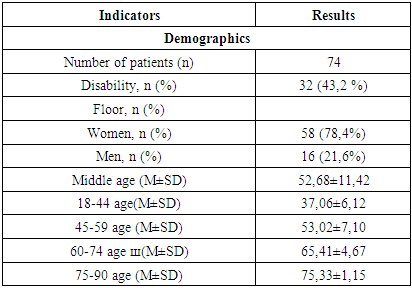
According to the analysis of the study, out of 74 (53.6%) patients, 58 (78.4%) were women, the average age of patients was 51.9±11.6, men – 16 (21.6%), the average age of patients was 51.9±11.6 the average age was 55.2±10.8. When analyzed by World Health Organization (WHO) age classification in 2021, 15 (20.3%) patients in the study were aged 18-44 years, 39 (52.7%) were aged 45-59 years , 17 (22.9%) were 60-74 years old, 3 (4.1%) were 75-90 years old (Table 1).
|
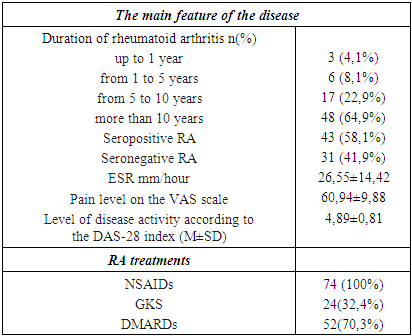
The study examined the characteristics of the underlying disease of patients, the duration of rheumatoid arthritis and life history, general results of a medical examination, a comprehensive laboratory test (complete blood count, complete urinalysis, determination of rheumatic factor, C-reactive protein, antispeptolysin-O, ACCP, biochemical blood test: bilirubin, ALT, AST, sugar level, urea, Helicobacter pylori determination, Gregersen fecal reaction to hidden bleeding, creatinine level; Coagulopathy and instrumental examination (radiography of joints, osteodencitometry, FGDS) were taken into account. The DAS-28 index and VAS scale were also used (Table 2).
|
According to the DAS-28 index, 1 patient (1.4%) had remission, 2 patients (2.7%) had low activity, 42 (56.8%) had II-moderate activity, and 29 (39.1%) – III-moderate activity (Figure 1).
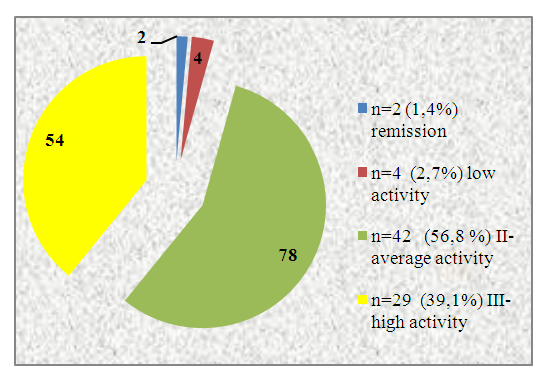 |
Figure 1. PA activity level |
When analyzing the risk factor by age in patients with RA, it was noted that the prevalence of asthma was higher in 18-44 and 45-59 year olds, while alcohol and smoking were more common in 45 year olds. Group 59 years old (Table 3).
|
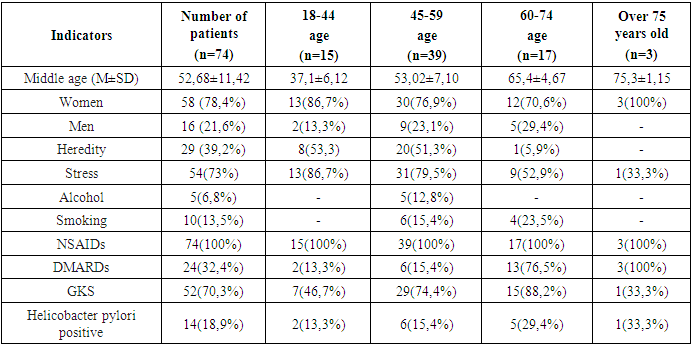
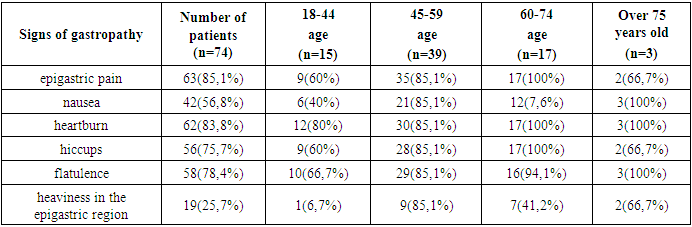
When analyzing the symptoms of gastropathy, pain in the epigastric region was observed in 85.1%, nausea – in 56.8%, heartburn ng – in 83.8%, hiccups – in 75.7%, flatulence – in 78.4%, heaviness in the epigastric region – 25.7%. patients, if we analyze these indicators by age, they prevailed in patients 60-74 years old and over 75 years old (Table 4).
|
55 of 74 patients who took part in the study (74.3%) underwent an FGDS examination; superficial and atrophic changes in the submucous membrane of the gastroduodenal zone, cysts, erosions and ulcers were revealed. Antral 19 (34.5%), fundic 10 (18.2%), pangastritis 8 (14.5%), erosion 11 (20%), ulcer 7 (12.8%) (Figure 2).
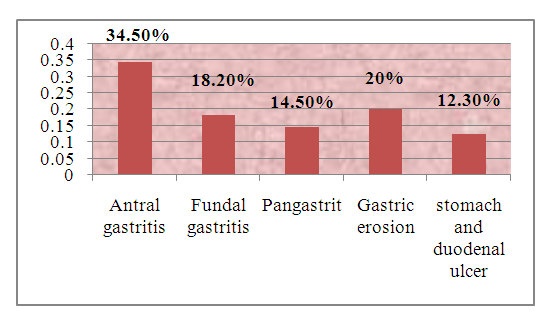 |
Figure 2. Morphological changes in the gastric mucosa |
According to the results of the analysis of morphological changes in the gastric mucosa, shown in Figure 2, the majority of patients were diagnosed with antral gastritis – 34.5%, fundal gastritis – 18.2%, pangastritis – 14.5%, erosion – 20%, stomach and duodenum . Peptic ulcer disease was observed in 12.8% of patients. All patients with antral gastritis had constant dull, throbbing pain in the epigastric region. Among the symptoms of dyspepsia, only belching, hiccups and decreased appetite were observed; pain with fundic gastritis was also constant, but dyspeptic symptoms were more pronounced: belching, hiccups, nausea, vomiting, discomfort in the epigastric region. According to the results of an X-ray examination, out of 19 patients, 9 (47.4%) had erosive gastritis, 6 (31.6%) had pangastritis, and 4 (21%) had peptic ulcer (Figure 3).
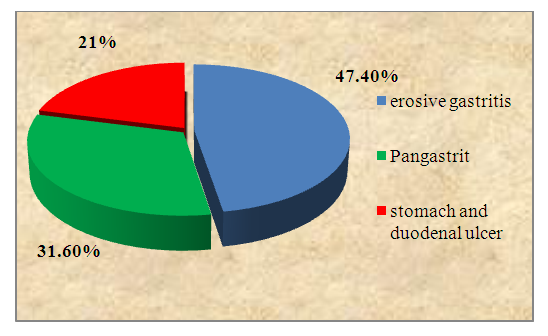 |
Figure 3. Results of fluoroscopy in patients with gastropathy |
A statistically significant linear relationship (R<0.05) was established between the nature, course, clinical and morphological features of the lesion in the gastroduodenal area, the level of activity, the stage of RA and the presence of visceritis. In addition, a statistically significant correlation (R<0.05) was found between the severity of gastropathy and the use of NSAIDs, the duration of treatment with these drugs and the use of GCS. This allows us to confirm the above assumption that changes in the digestive tract are the result of the negative effect of anti-inflammatory drugs. By disrupting protective mechanisms, NSAIDs and corticosteroids contribute to damage to the mucous membrane, which has already changed the underlying disease.
Risk factors for the development of NSAID gastropathy in patients with RA are old age (r=0.501), female gender (r=0.718), smoking (r=0.835), alcohol consumption (r=0.835), character disorder (r=0.647), and disordered diet (r=0.912), long-term treatment with NSAIDs (r=0.509), physical work (r=0.583), heredity for diseases of the gastrointestinal tract (r=0.712), a history of gastric ulcer and duodenal ulcer intestines (r=0.912). The results obtained are presented in the table.
4. Conclusions
1. Gastropathy caused by NSAIDs is often detected in women in the presence of autoaggression factors (stress, heredity, gender, drug polyprogamy, the presence of H. pylori, taking antiplatelet agents), as well as when taking NSAIDs with water for more than five years;
2. NSAID gastropathy is manifested predominantly by dyspeptic syndrome (85.1%), the absence of the usual pain syndrome and seasonality. When a pain syndrome was detected, it was found that its elimination was achieved not with food and antacid medications, but with the help of gastroprotective and antibacterial agents for 2-3 days;
3. NSAID gastropathy is characterized by a discrepancy between the clinical and endoscopic manifestations of inflammation in the stomach. The mild symptomatic clinical course of NSAID gastropathy corresponds to clear endoscopic and morphological signs of antral gastritis activity;
4. Endoscopic examination of patients with RA made it possible to describe in detail the clinical and functional state caused by the aggressive effect of NSAIDs and glucocorticosteroids on the gastric mucosa, to scientifically substantiate the inclusion of drugs that protect the gastric mucosa in the complex treatment of patients in order to prevent inflammation of the gastric mucosa and their subsequent severe complications.