
Full text
Source and licence. Originally published by Scientific & Academic Publishing in American Journal of Medicine and Medical Sciences, Vol. 15 No. 10 (2025), pp. 3490-3492, DOI 10.5923/j.ajmms.20251510.44. Republished under the Creative Commons Attribution 4.0 International licence (CC BY 4.0). View the original article.
1. Introduction
Today, the annual external dose from natural background radiation averages approximately 1 mSv/year, with cosmic contributions being somewhat smaller than terrestrial contributions. The contribution from inhalation is higher than that from external exposure. It is worth noting that: (i) the average annual natural background dose of 2.4 mSv corresponds to a low dose rate of ≈ 0.27 μSv/h; (ii) in several areas of the world, such as Guarapane in Brazil, Ramsar in Iran, Yangjiang in China and Kerala in India, natural background radiation levels are higher than those considered to be “normal background” [5,6], such that they have been designated as high natural background radiation (HNBR) areas [4,5,7]; (III) the assessment of exposure by inhalation and ingestion is strictly related to humans and may not be applicable to other organisms, especially to cultured cells frequently used in radiobiological experiments [1,3].
Radon and its radioactive decay products make the main contribution to the radiation background of residential and industrial premises. Radon is formed during the decay of natural radionuclides contained in earth rocks and dissipates in the atmosphere. In this regard, during engineering surveys of construction sites, radiation and environmental studies are carried out, an integral part of which is the assessment of the radon hazard of the territory. Currently, there is no universal method for determining the radon hazard of an area in the world. This is explained by the fact that radon concentrations and flows are extremely uneven and depend on both the geological and geophysical characteristics of the natural environment (uranium and thorium content in the soil, the structure of the underlying rocks and the level of groundwater, climatic conditions), and on the design of buildings, building materials and the quality of ventilation systems. Therefore, different countries have their own approaches to determining radon hazard [7].
International organizations (WHO, ICRP) have issued recommendations regarding the level of radon exposure due to its high potential to increase the risk of lung cancer. In December 2013, the Council of the European Union prepared new European Basic Safety Standards (EU BSS). This regulation sets the permissible average annual radon concentration at no more than 300 Bq/m3 in residential and working areas [8]. Meanwhile, the International Atomic Energy Agency (IAEA), in accordance with IAEA Safety Standards Series No. GSR Part 3, recommends that radon concentrations in the general population and workers should not exceed 300 Bq/m3 and 1000 Bq/m3, respectively [4].
Indoor radon concentrations vary widely, including within small geographic areas, and range from less than 10 Bq/m3 to about 50,000 Bq/m3 in Norway. Key geological parameters for assessing radon potential include uranium concentration and soil permeability. Although good statistical correlations can be achieved [5,6], in practice it has proven almost impossible to make reasonable predictions of radon concentrations in a given building based on information about the geology or indoor radon in nearby buildings. The Norwegian Radiation Protection Authority (NRPA) therefore recommends radon measurements in all homes (except apartments on the second floor and above), workplaces and other buildings with high occupancy [5].
2. Purpose of the Research
The purpose of the study is to adiation and hygienic assessment of radon content in the air of residential premises in the Jarkurgan district and substantiation of criteria for ensuring radiation safety of the population.
3. Materials and Methods
Natural sources of ionizing radiation (NSIR) – gamma radiation from the soil, cosmic radiation and, mainly, radon make the main contribution to the radiation dose of the population – up to 70% [1]. At least 10% of lung cancer cases registered annually in the world are caused by radon [1,2]. It is the second risk factor for the development of lung oncopathology after smoking. Since human exposure to radon occurs indoors, monitoring the levels of population exposure indoors is of particular importance. In the regulatory documents NRB-2006 [3], in order to limit population exposure, restrictions are established on exposure to natural sources: in residential and public buildings, the average annual equivalent equilibrium volumetric activity (EEVA) of radon in the air of premises should not exceed 200 Bq/m3.
Assessment of radon content in the air of residential buildings
Radon in the air of residential buildings was measured using the Radon FTLAB FRD400 device. The FRD400 radon monitor combines a user-friendly interface, elegant gray optics, accurate measurement results and powerful hardware. The device is equipped with an ionization pulse chamber; the first readings are available 30 minutes after the start of the measurement. The device is also equipped with a multi-color 1.8-inch LCD display, there is hourly storage of measured data, which can be transmitted via Bluetooth or USB, and there is also data analysis using computer software. The highest radon concentrations are usually found on the lowest floor of the building. However, due to the structure of the chimney, radon also rises to the floors above. Therefore, we recommend always measuring at least one room on the first or second floor to obtain comparative values. Radon penetration paths usually vary from room to room. It is advisable to measure all rooms on the lowest floor.
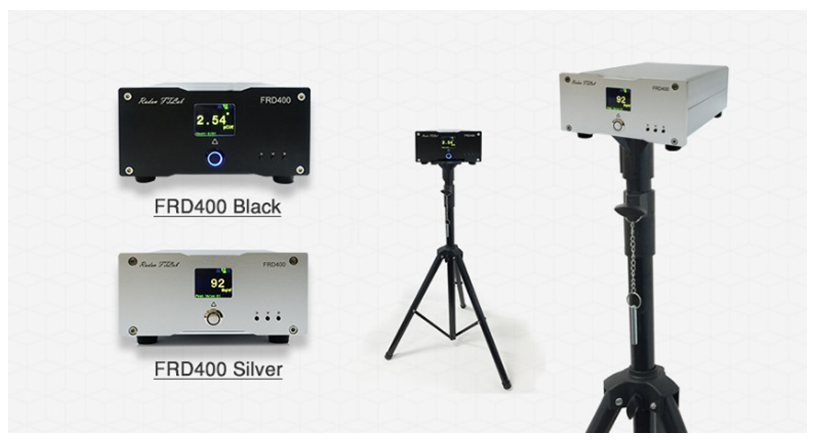 |
Figure 1 |
The radon meter was installed at 5 points in each measured room. The radon meter for measurements was placed mainly in rooms with the longest stay of inhabitants. The first readings were recorded 30 minutes after the start of the measurement, further readings were updated every 10 minutes. At each point, measurements were taken 5 times for reliability.
4. Results and Discussion
Jarkurgan district is a territorial entity in the southeast of the Surkhandarya region. It lies in the vast valley of the Surkhandarya River and on the ridges of the Babatag Mountains. The district center, the city of Jarkurgan, is located on the main road and railway of the region. This region has an arid semi-desert climate, and agriculture is provided by irrigation canals. Oil and gas fields have been explored on the plain, and raw materials for building materials are mined in the mountains. In addition to the agricultural sector, light industry, trade and services play an important role.
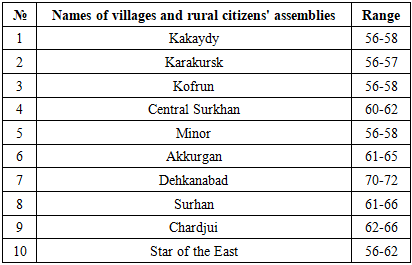
According to measurements conducted at the measurement points of the Jarkurgan district during the cold period, the values of the EEVA of radon isotopes and their decay products (DP) in the atmospheric air are in the range of: 56-72 Bq/m3. The average value for the district is 61 Bq/m3.
|
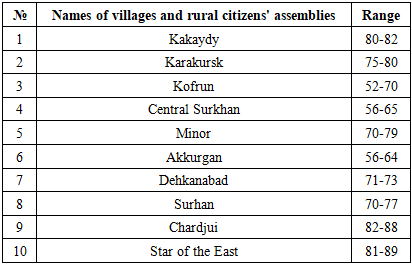
According to measurements conducted at the measurement points of the Jarkurgan district during the warm period, the values of the EEVA of radon isotopes and their decay products (DP) in the atmospheric air are in the range of: 52-89 Bq/m3. The average value for the district is: 73 Bq/m3.
|
5. Conclusions
The radiation situation in the surveyed buildings of the Jarkurgan district is generally quite acceptable. The situation with population exposure in the Jarkurgan district generally complies with the requirements of the Radiation Safety Standards. Most cases of lung cancer caused by radon are caused by low and medium radon concentrations rather than high ones. As a result, the goal should be to reduce both the individual risk of the most exposed individuals to a reasonably achievable level and the overall risk for the entire population. At the same time, complete elimination of radon exposure is impossible.